
Welcome to my guide on 7 bicep workouts! Here, I’ll cover the best exercises to boost your arm strength and grow your muscles. Bicep workouts are key to bigger biceps. Learning the right techniques is vital for your fitness journey.
I’ll share routines for all fitness levels. This way, everyone can find a workout that fits them. By the end, you’ll know how to work on your biceps safely and effectively.
Key Takeaways
- Effective bicep workouts are essential for improving arm strength.
- Focus on a mix of exercises for building bigger biceps.
- Proper techniques enhance muscle growth and minimize injury risk.
- Workout routines should accommodate all fitness levels.
- Consistency is key for significant progress in bicep development.
Understanding the Anatomy of the Biceps
The biceps is a key muscle on the front of the upper arm. It’s loved for its looks and strength. It has two parts, the long head and the short head, and is important for many arm movements.
This muscle helps bend the elbow and turn the forearm. When training the biceps, it’s important to work both heads. This helps build a balanced and strong muscle that looks good too.
Why Bicep Workouts Are Essential for Arm Strength
Bicep workouts are key for stronger arms. They make my arms look good and help me do everyday tasks. Activities like lifting groceries or playing sports need strong biceps.
Strong biceps help me do better in exercises like pull-ups and bench presses. This shows how important bicep training is for overall strength. Without strong biceps, I’d find it hard to do many things, showing how crucial these workouts are.
Most Effective Biceps Workouts
Building strong arms starts with the right biceps workouts. Effective routines make every rep count. Exercises like curls and chin-ups are key for shaping biceps and boosting strength.
Key Exercises for Optimal Results
For the best results, focus on key bicep exercises. Dumbbell curls, barbell curls, and hammer curls work the biceps in different ways. They help activate muscle fibers fully. Mixing these exercises keeps my training balanced and effective.
Incorporating Variations for Muscle Growth
Adding muscle growth variations keeps my muscles challenged. I mix in alternating curls and reverse curls. Changing grip widths and angles also increases intensity and targets different bicep parts. This variety leads to steady muscle growth and stronger arms.
Best Arm Exercises for Comprehensive Development
To get strong arms, it’s key to mix compound and isolation exercises. Knowing the value of each helps craft a solid workout plan. Pairing exercises boosts muscle work and aids in full development.
Compound vs. Isolation Movements
Compound exercises are crucial for a good workout. Pull-ups, bench presses, and rows work many muscles at once. They’re top choices for arms because they work both biceps and triceps, balancing muscle growth.
Isolation exercises, like bicep curls and tricep pushdowns, target one muscle. This focused effort leads to better growth, especially for biceps. Mixing both kinds of exercises helps build strong and big arms.
How to Pair Exercises for Maximum Effect
Pairing exercises makes workouts more effective for muscle growth and endurance. Combining a compound exercise with an isolation one maximizes gains. For instance, pairing barbell curls with tricep extensions works both biceps and triceps well.
Here’s a table showing some great pairings for arm exercises:
| Compound Movement | Isolation Movement |
|---|---|
| Pull-Ups | Bicep Curls |
| Bench Press | Tricep Pushdowns |
| Dumbbell Rows | Hammer Curls |
| Overhead Press | Concentration Curls |
Using these strategies in my workouts has led to great results. It helps build stronger, more defined arms. By combining compound and isolation exercises and pairing them wisely, I achieve better performance and look.
Top Workouts for Stronger Biceps
Building a good bicep workout routine is key for stronger, more defined arms. I mix exercises that grow muscles and boost strength in my routine. Here are some routines that have helped me.
Sample Workout Routines to Try
A good bicep workout includes these exercises:
- Barbell Curls
- Hammer Curls
- Concentration Curls
Doing these exercises in supersets boosts intensity and results. For example, pairing barbell curls with hammer curls keeps my heart rate up and targets different muscles.
Weekly Workout Schedule for Consistent Gains
To keep improving, I work out my biceps twice a week. Here’s my weekly plan:
| Day | Workout |
|---|---|
| Monday | Barbell Curls – 4 sets of 10 reps, Hammer Curls – 4 sets of 12 reps |
| Thursday | Concentration Curls – 3 sets of 10 reps, Superset with Barbell Curls – 3 sets of 8 reps |
Sticking to my workout schedule is crucial for progress. It’s also important to rest to help muscles grow and perform better.
Effective Bicep Training Tips to Boost Your Performance
To get the most out of my bicep workouts, I focus on a few key things. I always make sure to keep the right form and control. This means moving slowly and steadily, which helps my muscles work harder.
Adding more weight over time is also crucial. It keeps my biceps challenged and growing. This approach helps me see real improvements in my strength.
Don’t forget about rest and recovery. Giving my muscles time to heal is just as important as the workout itself. It helps prevent injuries and lets me keep pushing my limits.
By following these tips, my bicep workouts become more effective. It’s all about the little details that make a big difference.
Bicep Workout Routine for All Fitness Levels
Creating a bicep workout routine that fits your fitness level is key. Whether you’re new to lifting or have been doing it for years, there’s a routine for you. Beginners should start with simple curls and lighter weights to build a strong base.
Intermediate lifters can add more complex exercises to their routine. This might include hammer curls or incline dumbbell curls. These exercises target the biceps from different angles. Advanced lifters can then use heavier weights and more varied exercises to keep challenging their muscles.
Adjusting the number of reps and sets can help meet your fitness goals. Whether you want to boost endurance or increase strength, a flexible workout routine lets you make these changes. This way, you can tailor your workout to your specific goals.
| Fitness Level | Suggested Exercises | Reps/Sets |
|---|---|---|
| Beginner | Bicep Curls, Concentration Curls | 3 sets of 10-12 reps |
| Intermediate | Hammer Curls, Incline Dumbbell Curls | 4 sets of 8-10 reps |
| Advanced | Cable Curls, Barbell Curls | 5 sets of 6-8 reps |
Proven Biceps Exercises for Maximum Muscle Gains
To get the most muscle gains, I choose proven biceps exercises. I look at free weights and machines to see which works best. Each has its own benefits, fitting different training styles and goals.
Using Free Weights vs. Machines
Free weights like dumbbells and barbells are better for biceps than machines. They make my biceps work harder because I control the weight. This way, I can hit my biceps from different angles, helping them grow more.
Machines are good for isolating muscles but don’t challenge them as much. They support the weight, which means my stabilizing muscles don’t work as hard.
Importance of Correct Form and Technique
Keeping the right form is key for safety and getting the most out of your workout. I always aim for proper posture and movement. For example, when doing bicep curls, I keep my elbows still.
This helps my biceps handle the most weight, reducing injury risk and boosting muscle use. Sticking to good form helps me get stronger and bigger over time.
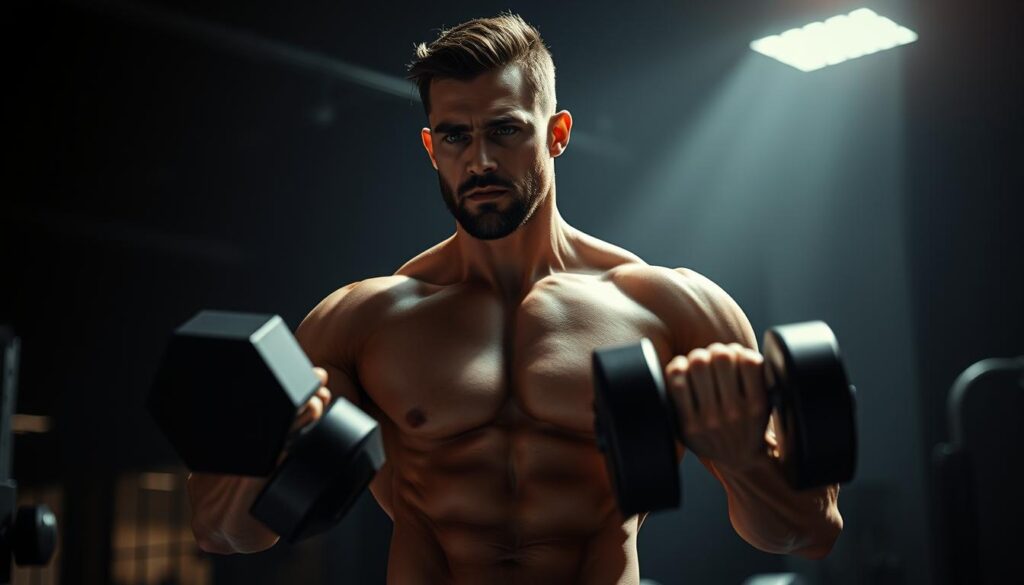
Tracking Progress in Your Bicep Workouts
Tracking my bicep workouts gives me valuable insights. I log each workout, using methods that ensure I track everything accurately. By recording weights, reps, and sets, I can see how much I’ve improved over time.
Every few weeks, I do a deep dive into my progress. This helps me spot trends in my strength and endurance. Seeing my lifting get stronger motivates me. If I hit a plateau, I change up my routine to keep pushing myself.
To make tracking easier, I use a workout journal and a mobile app. These tools help me stay organized and motivated. With regular tracking, I stay focused on getting the most out of my workouts.
Conclusion
Building stronger biceps is an exciting journey. It involves understanding muscle anatomy, effective training, and consistent workouts. By doing different exercises, I’ve not only strengthened my biceps but also improved my arms.
Progress is crucial; it lets me challenge myself and see results. I’ve learned that recovery is just as important as working out. This way, my muscles can grow and adapt. With dedication and the right plan, reaching my bicep goals is possible.
Whether I’m new to fitness or experienced, effective training makes a big difference. Keeping a balanced routine and checking my progress helps me get the strong arms I want.